Is an ackie monitor right for you?
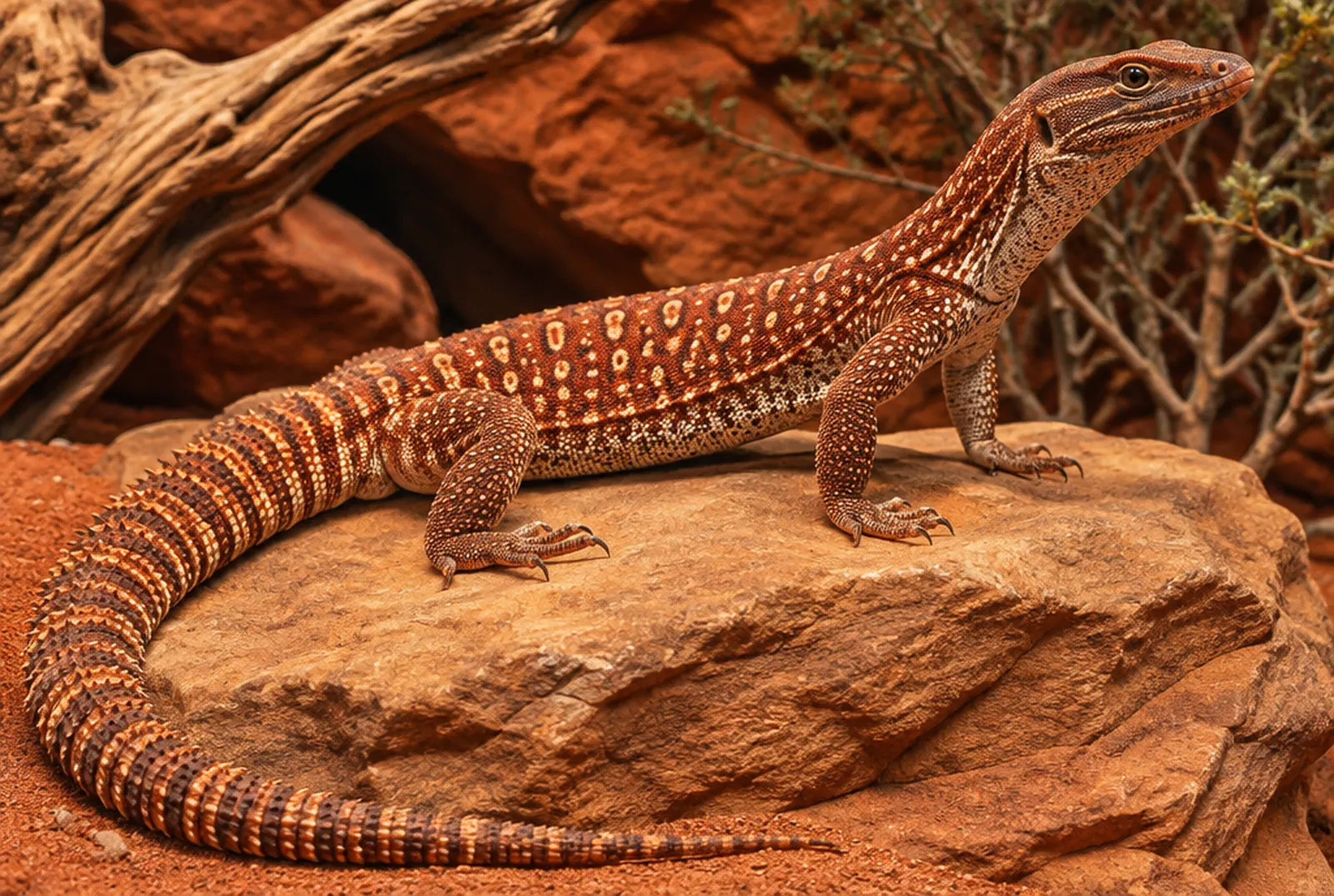
Ackie monitors (Varanus acanthurus), also called ridge-tailed or spiny-tailed monitors, come from arid, rocky country in northern and northwestern Australia. They're intelligent, curious and very active, spending their days basking, digging and patrolling for food. That makes them far more engaging than most lizards, but also more demanding.
They're best for keepers who have already kept a lizard well and are ready to build a large, deep, very hot enclosure. Temperament varies: some ackies tolerate handling calmly, while others stay flighty and may tail-whip or bite. Hand-feeding with tongs is often the best way to interact.
Enclosure
| Animal | Minimum | Better |
|---|---|---|
| Hatchling/juvenile | Can go straight into the adult enclosure if well furnished | — |
| Adult (one ackie) | 5×2.5×4 ft (L×W×H) | 6×3×4 ft or larger |
The height isn't for climbing. It's to hold a very deep layer of substrate (at least 12 inches / 30 cm) so the ackie can dig proper burrows. Front-opening PVC or wood enclosures with a tall lip at the front are ideal.
Keep one ackie per enclosure. Groups and pairs are sometimes kept by experienced breeders in very large enclosures, but cohabiting commonly leads to stress, injuries and one animal being outcompeted for food and basking spots.
Heating
Ackies are among the hottest-basking lizards kept as pets:
- Basking surface: 158–172°F (70–78°C), measured with an infrared thermometer. Juveniles may prefer the lower end.
- Warm-side air: roughly 84–100°F (29–38°C)
- Cool side: 75–82°F (24–28°C)
- Night: a drop to around 70°F (21°C) is fine
Build the basking area as a "Retes stack": layers of flat slate or tile separated by spacers, so the ackie can crawl between layers and pick its exact temperature. Heat it with a cluster of at least two halogen flood bulbs so the hot zone is large enough to warm the whole body. Run them through a dimming thermostat.
Lighting and UVB
UVB is essential. Use a T5 high-output UVB tube of about 10–12%, covering at least half to two-thirds of the enclosure length on the basking side. As a guide from common care sources, an inside-mounted tube is typically positioned so the ackie's back is roughly 12–15 inches (30–38 cm) below it when basking; over mesh, much closer. Follow the manufacturer's distance guidance, and replace tubes every 12 months.
Humidity and substrate
Ackies are an arid species above ground, but they spend a lot of time in burrows that are much more humid. Recreate that:
- Keep air humidity around 40–60%, with good ventilation.
- Use a deep sand/soil mix that holds a burrow without collapsing (roughly 60% topsoil, 40% sand is a common starting point).
- Pour water into the substrate regularly (a watering can works well) so the lower layers stay moist while the surface stays dry.
A probe hygrometer buried in the substrate helps you track burrow humidity.
Diet and supplements
Ackies are mostly insectivores. Offer a wide variety: dubia and red runner roaches, crickets, black soldier fly larvae, silkworms, hornworms and superworms. Occasional whole prey (such as a pinky mouse for adults) can be offered sparingly.
| Age | Feeding |
|---|---|
| Hatchlings and juveniles | Daily, as many appropriately sized insects as they'll eat in a session |
| Adults | Most days or every other day, adjusting to body condition |
Feed insects no larger than the ackie's head. Dust most feedings with calcium, and use a multivitamin about once a week. Ackies are enthusiastic eaters and can become obese, so watch for fat pads building up at the base of the tail.
Common mistakes
- Basking spot far too cool. Ackies need far more heat than bearded dragons.
- Shallow substrate, which leads to stress and poor hydration.
- Weak or coil UVB bulbs.
- Undersized enclosures. Older 4×2×2 ft recommendations don't give ackies room to dig and thermoregulate.
- Cohabiting without a very large setup and experience.
Signs of a healthy ackie
Alert, active during the day, a strong feeding response, regular droppings, complete sheds and a rounded (not swollen) tail base. Lethargy, refusal to eat outside of cool-season slowdowns, swollen limbs or jaw, or retained shed warrant a reptile vet.
FAQ
What size enclosure does an ackie monitor need? At least 5×2.5×4 ft for one adult, with very deep substrate.
How hot should an ackie's basking spot be? About 158–172°F (70–78°C) at the surface, with a cool side of 75–82°F (24–28°C).
Do ackie monitors need UVB? Yes: a T5 high-output tube of around 10–12%.