ReptiGuide is reader-supported. When you buy through links on this page we may earn a commission, at no extra cost to you. Learn more.
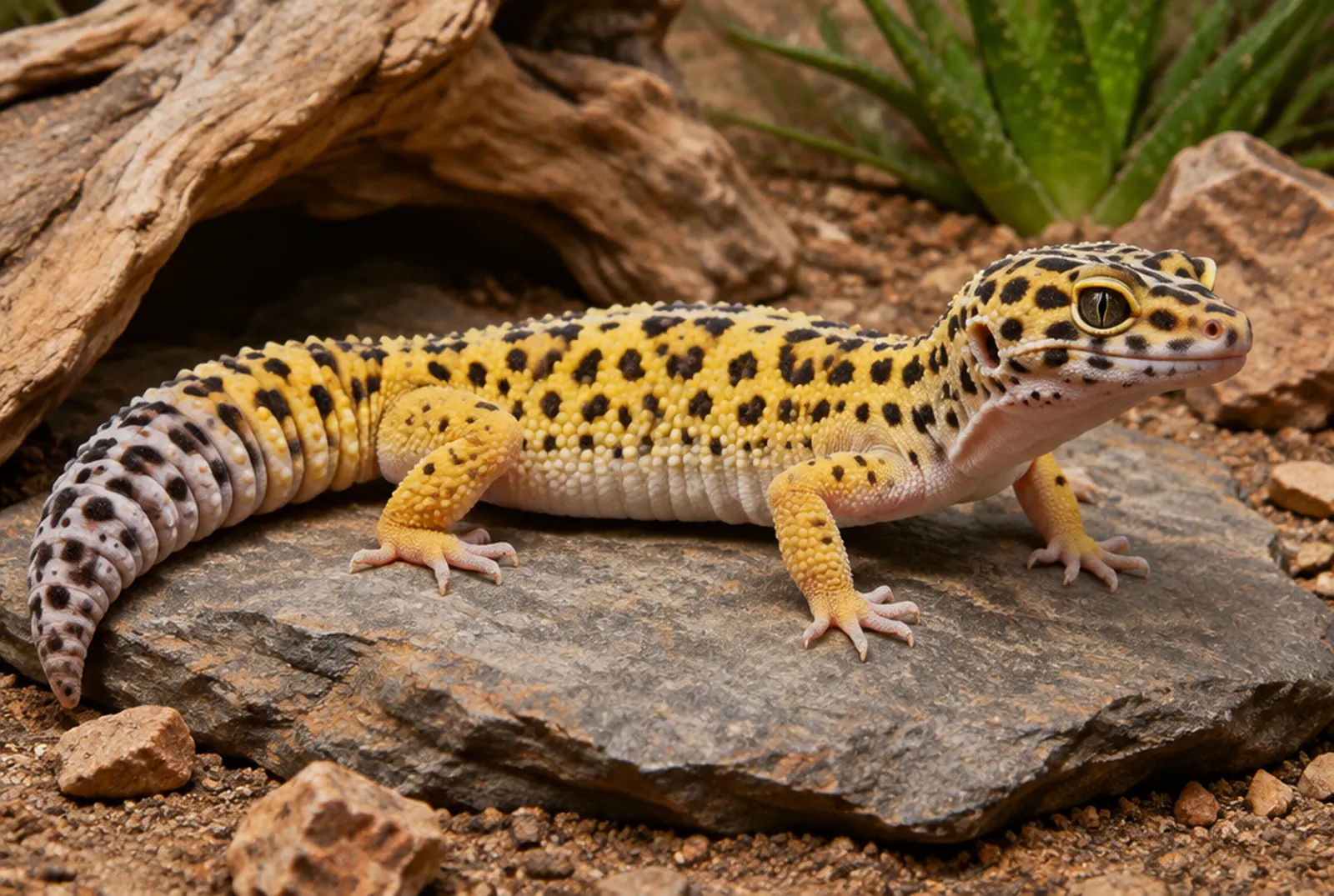
Is a leopard gecko right for you?
Leopard geckos (Eublepharis macularius) come from dry, rocky grassland and scrub across Afghanistan, Pakistan, northwest India and Iran. They're ground-dwelling, mostly active at dusk and dawn (crepuscular), rarely bite and usually tolerate handling well. Unlike most geckos they have eyelids and no sticky toe pads, so they walk rather than climb glass.
They eat only live insects, so you'll need to be comfortable keeping and feeding crickets, roaches or larvae. Many live well past 20 years.
Enclosure
| Animal | Minimum | Recommended |
|---|---|---|
| Juvenile | 20-gallon long (30×12×12 in) | Can go straight into the adult enclosure |
| Adult (one gecko) | 36×18×18 in (≈40-gallon breeder) | 48×24×24 in (4×2×2 ft) |
Leopard geckos use floor space, so a long enclosure beats a tall one. A front-opening design makes feeding and spot-cleaning easier.
Provide at least three hides:
- Warm hide on the hot side.
- Cool hide on the cool side.
- Humid hide: a box with damp sphagnum moss or coco coir, ideally in the middle. This is essential for clean shedding.
Add rocks, cork bark and low branches for climbing and enrichment. House leopard geckos one per enclosure; males will fight, and cohabiting females often stress each other.
REPTI ZOO 40 Gallon Front-Opening Terrarium (36x18x18)
Front-opening glass, raised base for under-tank wiring, fits a 36 in UVB tube.
Heating
Leopard geckos need a temperature gradient from warm to cool so they can regulate their own body temperature.
- Basking surface (warm side): 90–95°F (32–35°C)
- Warm-side air: around 80–85°F (27–29°C)
- Cool side: 70–77°F (21–25°C)
- Night: a drop to 65–70°F (18–21°C) is natural and healthy
The modern recommendation is overhead heat (a halogen flood bulb or a deep heat projector over a flat basking stone), because it heats the whole animal from above, like the sun. Under-tank heat mats are still common and can be used as extra belly heat, but on their own they create a much weaker gradient.
Every heat source must run through a thermostat. Unregulated heat mats and bulbs regularly cause burns. Check the basking surface with an infrared temperature gun and the air with a digital probe thermometer. See our thermostat guide.
Lighting and UVB
Leopard geckos can be kept alive without UVB using vitamin D3 supplements, but low-level UVB is now considered best practice. Use a low-output T5 tube (often labelled 5–7% or "ShadeDweller"-type) spanning about half to two-thirds of the enclosure on the warm side, so the gecko can choose shade. Run a 12-hour day/night cycle on a timer.
Humidity
Keep overall humidity around 30–40%, with the humid hide giving a localized spot of high humidity for shedding. If you see shed stuck on toes or the tail tip, the humid hide needs re-dampening more often.
Substrate
Good options for adults:
- Soil and sand mix (roughly 60–70% organic topsoil to 30–40% play sand), which holds burrows and looks natural.
- Slate tile or paper towel, which is simple and easy to clean.
Avoid calcium sand, walnut shell and loose gravel. For juveniles, paper towel is the safest choice until they're feeding well.
Diet and supplements
Leopard geckos are insectivores. Offer a variety: crickets, dubia roaches, black soldier fly larvae and silkworms as staples, with mealworms, superworms and waxworms as occasional treats. Gut-load insects for 24 hours before feeding.
| Age | How often | Amount |
|---|---|---|
| Under 6 months | Daily | As many as eaten in ~10–15 min |
| 6–12 months | Every other day | As many as eaten in ~10–15 min |
| Adult (12 months+) | 2–3 times a week | 5–8 appropriately sized insects |
Supplements: dust insects with calcium (no D3) at most feedings, and with a calcium + D3 / multivitamin product about once a week. A small dish of plain calcium in the enclosure is also common practice. Always provide fresh water.
Repashy Calcium Plus LoD
All-in-one calcium and vitamin powder formulated for use alongside UVB.
Handling
Wait until your gecko is eating regularly before handling, usually 1–2 weeks. Scoop from underneath rather than grabbing from above, and never hold the tail: leopard geckos can drop it, and while it does regrow, it's stressful and uses their fat reserves.
Common mistakes
- Heat without a thermostat, which causes burns from heat mats.
- No humid hide, which leads to stuck shed and lost toe tips.
- Skipping calcium, the leading cause of metabolic bone disease.
- Feeding only mealworms. Variety matters.
- Too-small enclosures that make a proper gradient impossible.
Signs of a healthy leopard gecko
A plump tail (where fat is stored), clear eyes, a clean vent, regular feeding and complete sheds are good signs. A thin tail, wobbly or bent limbs, regurgitation, or a gecko that stops eating for weeks outside of a cool-season slowdown warrant a reptile vet visit.
FAQ
What size tank does a leopard gecko need? A 36×18×18 inch enclosure is a sensible minimum for one adult; 48×24×24 inches is better.
What temperature should a leopard gecko tank be? Basking surface 90–95°F (32–35°C), cool side 70–77°F (21–25°C), nights 65–70°F (18–21°C), all on a thermostat.
Do leopard geckos need UVB? Low-level UVB is now recommended alongside proper supplementation.