ReptiGuide is reader-supported. When you buy through links on this page we may earn a commission, at no extra cost to you. Learn more.
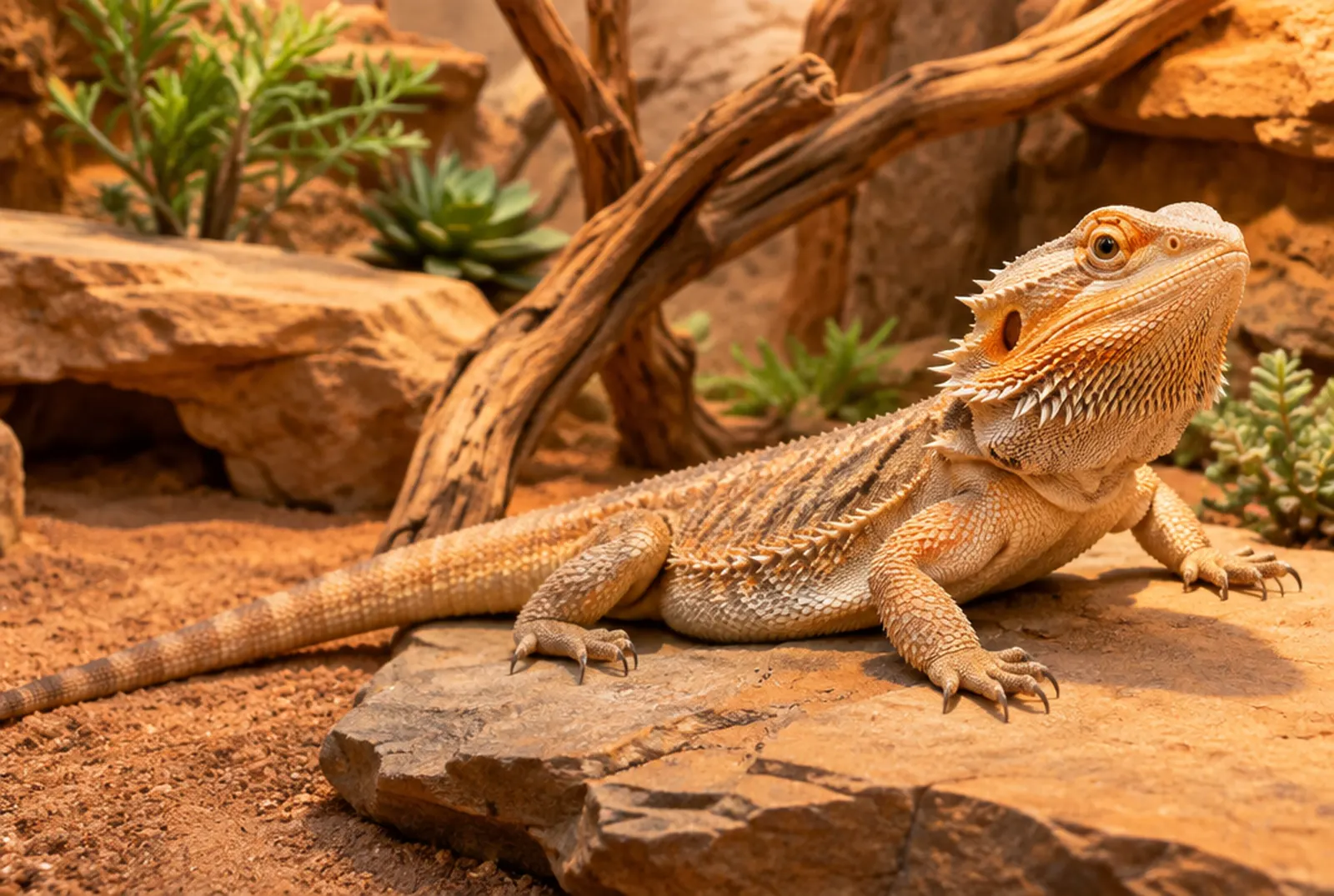
Is a bearded dragon right for you?
Bearded dragons (Pogona vitticeps) come from the arid woodland and scrub of central Australia. They're diurnal (active in the day), curious, and many enjoy time outside the enclosure, which makes them one of the most interactive pet reptiles.
They're also a real commitment: a large enclosure, strong lighting, daily fresh greens, and live insects, especially for juveniles. Budget for the setup before buying the dragon; a proper setup usually costs more than the animal.
Enclosure
| Animal | Minimum | Better |
|---|---|---|
| Juvenile | Can go straight into the adult enclosure | — |
| Adult (one dragon) | 4×2×2 ft (120 gallons) | 5×2.5×2 ft or larger |
Front-opening PVC or wood enclosures hold heat better than all-glass tanks and are easier to light properly. Older advice suggesting a 40-gallon tank for an adult is outdated.
Add a sturdy basking platform (a flat rock or cork log) under the heat and UVB, branches to climb, a couple of hides, and digging substrate. Never house bearded dragons together; they're solitary and cohabiting often leads to injuries and dominance stress.
Zen Habitats 4x2x2 Reptile Enclosure
A widely used flat-pack 4×2×2 enclosure that holds heat well and has room for a full-length UVB tube.
Heating
Bearded dragons need a strong basking area and a clear gradient:
- Basking surface: 100–110°F (38–43°C) for adults; juveniles can go a little warmer.
- Warm-side air: around 90°F (32°C)
- Cool side: 75–85°F (24–29°C)
- Night: 65–75°F (18–24°C). No light at night; extra heat is usually not needed unless your home gets very cold.
Use halogen flood bulbs for basking: they produce visible light and heat like the sun. Two bulbs clustered together create a wider, more even basking spot than one. Run them through a dimming thermostat, and measure the basking surface with an infrared temperature gun.
UVB lighting (essential)
Bearded dragons cannot stay healthy without proper UVB. Without it, they can't make vitamin D3, can't use calcium, and develop metabolic bone disease.
- Use a T5 high-output linear tube (labelled 10–14%), not a compact coil bulb.
- It should cover about half to two-thirds of the enclosure length, on the basking side.
- Mount it inside the enclosure or over a fine mesh. Glass and plastic block UVB entirely, and coarse mesh cuts a lot of it.
- The basking spot should sit at the distance recommended by the tube manufacturer (often roughly 12–18 in / 30–45 cm below an inside-mounted T5 HO), giving a UV index of roughly 3–6 at the dragon's back.
- Replace the tube every 12 months, even if it still lights up; UVB output fades long before visible light does.
We go deeper on this in our bearded dragon UVB setup guide.
Humidity
Keep humidity around 30–40%. Bearded dragons don't need misting, and persistently high humidity raises the risk of respiratory infections. Good ventilation matters.
Substrate
A soil and sand mix (about 60–70% topsoil to 30–40% play sand) lets dragons dig and holds a natural texture. Tile or paper towel are simple, easy-to-clean alternatives. Avoid calcium sand and walnut shell.
Diet
What a bearded dragon eats changes dramatically as it grows:
| Age | Insects | Greens/veg |
|---|---|---|
| Hatchling–6 months | ~70–80% of diet, 2–3 feedings a day | Fresh salad daily |
| 6–12 months | ~50%, once or twice a day | Fresh salad daily |
| Adult (12–18 months+) | ~20%, a few times a week | ~80%, fresh daily |
Good staple greens: collard greens, mustard greens, turnip greens, dandelion greens, endive/escarole, and squash. Treats only: fruit. Avoid: lettuce (no nutrition), spinach and other high-oxalate greens as staples, and never feed fireflies or wild-caught insects.
Staple insects: dubia roaches, black soldier fly larvae, crickets and silkworms. Superworms and waxworms are occasional treats. Insects should be no larger than the space between the dragon's eyes.
Supplements: dust insects with plain calcium at most feedings, and a multivitamin about once a week.
Repashy Calcium Plus LoD
Calcium and multivitamin powder designed for animals with good UVB.
Brumation
Many adult bearded dragons slow down in autumn and winter, eat less and sleep for days or weeks. This is called brumation and is normal. Before assuming it's brumation, rule out illness: a fecal check by a reptile vet is a good idea the first time. Keep water available and the lighting on its normal schedule.
Common mistakes
- Coil UVB bulbs or UVB behind glass. This is one of the leading causes of metabolic bone disease.
- Not replacing UVB tubes yearly.
- Too many insects for adults, which leads to obesity and fatty liver.
- Basking spot too cool, which causes poor digestion and appetite.
- Enclosures under 4×2×2 ft for adults.
Signs of a healthy bearded dragon
Alert, bright eyes, a strong grip, a full appetite (appropriate for age), regular firm droppings with white urates, and a dragon that basks and moves around through the day. Swollen or soft jaw or limbs, tremors, lethargy outside of brumation, or runny droppings need a reptile vet.
FAQ
What size enclosure does a bearded dragon need? At least 4×2×2 ft (120 gallons) for an adult; larger is better.
What UVB is best for a bearded dragon? A T5 high-output linear tube labelled 10–14%, covering half to two-thirds of the enclosure, replaced every 12 months.
How hot should a bearded dragon basking spot be? About 100–110°F (38–43°C) for adults, with a cool side of 75–85°F (24–29°C).