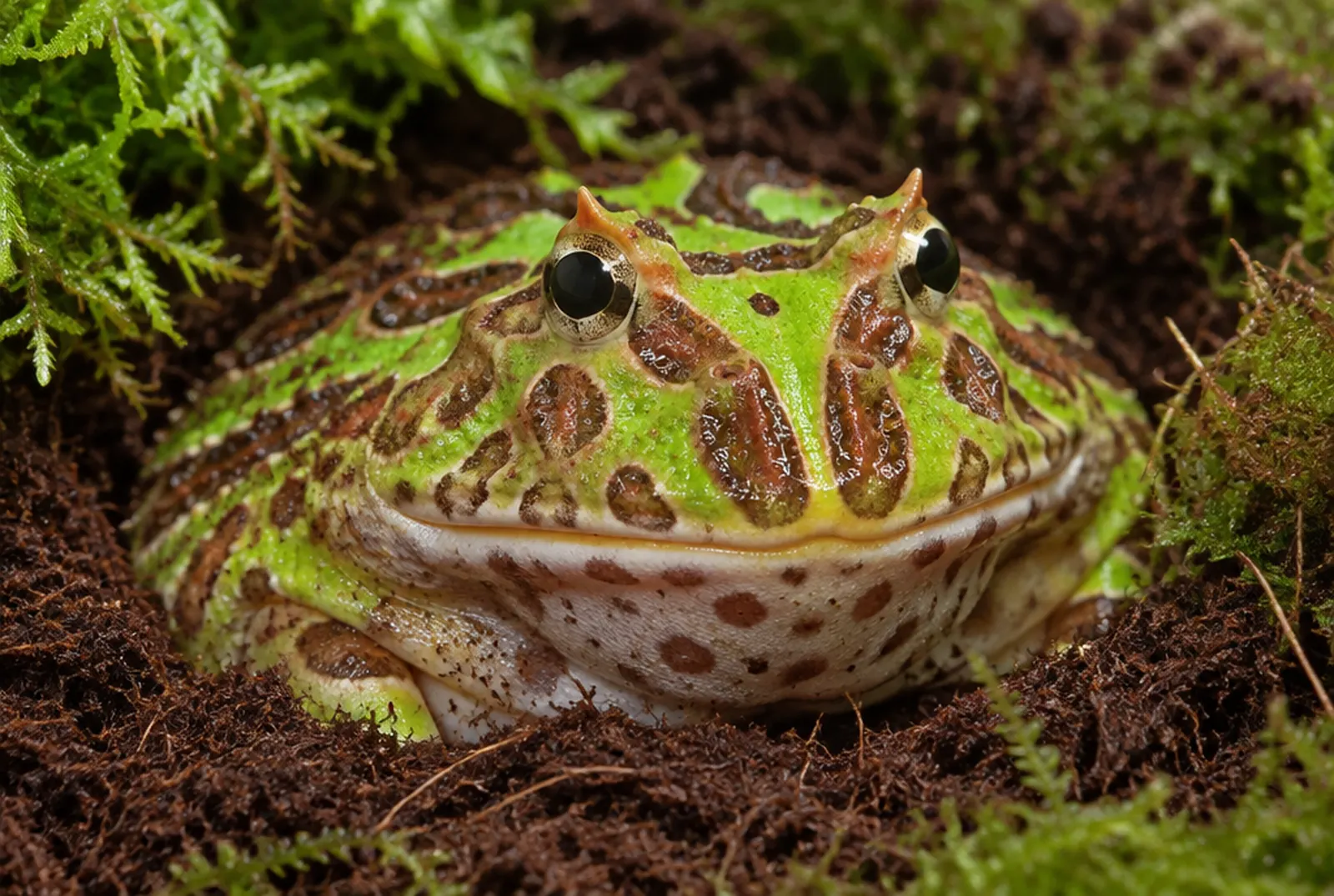
Is a pacman frog right for you?
Pacman frogs, or horned frogs (Ceratophrys species, most commonly C. cranwelli, C. ornata and their hybrids, the "fantasy" frogs), come from the grasslands of Argentina, Uruguay, Paraguay and southern Brazil. They're sit-and-wait ambush predators: they bury themselves in damp soil with just their eyes showing and lunge at anything that moves past.
That makes them low-effort and compact pets, but display animals rather than handling pets. They have a strong bite and powerful jaws, and amphibian skin absorbs whatever is on your hands.
Enclosure
| Frog | Enclosure |
|---|---|
| Juvenile | 10–20 gallons is fine while growing |
| Adult (one frog) | 24×18×18 in minimum; larger for big females |
Pacman frogs use floor space, not height. Glass terrariums with a secure, ventilated lid work well. Add plants (live or artificial), a piece of cork bark or a half-log, and a shallow water dish the frog can sit in without risk of drowning: its depth should be no more than about half the frog's height.
Always house alone. Pacman frogs are cannibalistic and will attempt to eat tankmates.
Temperature
- General air temperature: 75–80°F (24–27°C)
- Warmer zone: 82–85°F (28–29°C)
- Night: 65–70°F (18–21°C)
- Avoid going above about 85°F (29°C). Overheating is dangerous for amphibians.
A low-wattage heat bulb or a heat mat on the side of the glass, run through a thermostat, keeps temperatures steady. Measure with a digital probe thermometer at substrate level.
Lighting and UVB
Pacman frogs don't strictly need UVB, but a low-output UVB tube (often sold as 5–7% or "ShadeDweller"-type) with plenty of cover is increasingly recommended and supports natural vitamin D3 production. Run lights on a 12-hour day/night timer.
Humidity, substrate and water
- Keep humidity at 60–80%, misting once or twice a day.
- Use 3–4+ inches of moisture-holding substrate, such as coco coir or an organic soil mix, so the frog can bury itself. It should be damp, not soggy.
- Always use dechlorinated water for misting and the water dish. Tap water treated with a water conditioner is fine. Chlorine and chloramine harm amphibian skin.
- Change the water dish daily (frogs often soak and defecate in it) and spot-clean waste promptly.
If a pacman frog is kept too dry or cool, it may form a waxy cocoon and stop eating (a dormancy state). Restoring humidity and temperature usually brings it out.
Diet
Pacman frogs eat insects and worms: dubia roaches, crickets, nightcrawlers/earthworms, black soldier fly larvae and silkworms. Gel or powdered frog diets made for horned frogs are also popular and can be a convenient part of the diet.
| Age | Frequency |
|---|---|
| Juveniles | Every 1–2 days |
| Adults | 2–3 times a week, adjusting to body condition |
Use feeding tongs; they help you avoid a bite and keep substrate out of the frog's mouth. Prey should be no wider than the frog's head. Dust insects with calcium at most feedings and a multivitamin about once a week. Pinky mice should be a rare treat at most: rodent-heavy diets lead to obesity and health problems.
Handling
Keep handling to a minimum, ideally only when necessary. If you must, wear powder-free nitrile gloves moistened with dechlorinated water, or make sure your hands are rinsed of soaps and lotions. Expect a defensive bite.
Common mistakes
- Untreated tap water.
- Overfeeding, especially rodents, which causes obesity.
- Wet, dirty substrate that's never changed.
- Overheating above about 85°F.
- Housing two frogs together.
Signs of a healthy pacman frog
Round but not bloated, a strong feeding response, clear eyes, clean skin and regular sheds (which the frog often eats). Red or cloudy skin, bloating, lethargy when warm and humid, or refusing food for weeks warrant an exotics vet.
FAQ
What size tank does a pacman frog need? A 24×18×18 inch enclosure is a good minimum for one adult.
What temperature does a pacman frog need? About 75–80°F air with a warmer zone of 82–85°F, nights 65–70°F.
Can pacman frogs live together? No. They're cannibalistic; always house alone.